
Fluidline Insights · Technical
Three pipe threads. Near-identical sizes. Completely different ways of sealing. Getting them mixed up is one of the most common causes of leaks we see on instrumentation installs across Africa, and it usually shows up at pressure test.
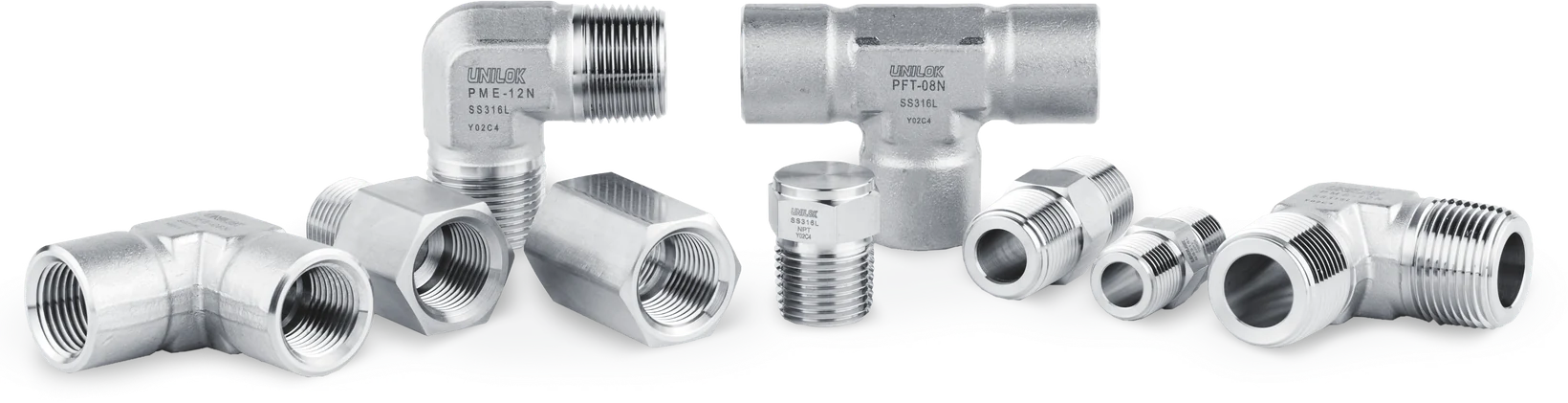
A 1/2″ NPT male and a 1/2″ BSPT male both have 14 threads per inch. Hold them side by side and most people can't tell them apart. Screw one into the other's port and it will often go two or three turns, then feel tight, which looks a lot like a good connection. It isn't. The thread forms don't match, and the connection can weep, or fail outright, once the system is pressurised.
Quality tube fitting and pipe fitting manufacturers, including Uni-Lok, which Fluidline distributes, all offer these end connections side by side, and they all publish thread identification guides for the same reason: the thread is where the tube fitting meets the rest of the plant, and a perfect compression connection doesn't help if the pipe-thread end leaks.
The three threads at a glance
| NPT | BSPT (ISO 7-1) | BSPP ‘G’ (ISO 228-1) | |
|---|---|---|---|
| Full name | National Pipe Taper | British Standard Pipe Taper | British Standard Pipe Parallel |
| Governing standard | ASME B1.20.1 | ISO 7-1 / EN 10226-1 (formerly BS 21), DIN 2999, JIS B0203 | ISO 228-1 (formerly BS 2779), JIS B0202 |
| Form | Tapered, 1:16 (1°47′) | Tapered, 1:16 (1°47′) | Parallel (straight) |
| Thread angle | 60° | 55° (Whitworth) | 55° (Whitworth) |
| Crests & roots | Flat | Rounded | Rounded |
| Where it seals | On the thread flanks (interference fit) | On the thread flanks (interference fit) | Not on the threads. On a bonded washer, ED seal, O-ring or gasket against the port face |
| Drawing symbols | NPT | R = male taper Rc = female taper Rp = female parallel (mates with R) | G (male G-A / G-B tolerance classes) |
| Uni-Lok designator | N | R | G |
| Common in | USA and Canada, and North American instruments and valves | UK, European and Asian equipment, and existing plant pipework | UK, Europe, Asia, Australia and African markets: hydraulics, gauges, transmitters, process ports |
What each thread looks like
The differences are small to the eye but decisive in service. The drawings below are redrawn from Uni-Lok's pipe thread data.
A 55° thread and a 60° thread can never form a proper metal-to-metal seal together. A mismatched pair only touches at the crests, leaving a spiral leak path.
Tapered threads: NPT and BSPT
Both NPT and BSPT taper at 1:16 on diameter. As the male is tightened into the female, the flanks wedge together, and it's this metal-to-metal interference that makes the seal. The tighter the fit, the harder the flanks bear on each other.
PTFE tape or a thread paste is used on every tapered connection, but in my experience its main job isn't to “make” the seal. It lubricates and protects the threads, stopping stainless-on-stainless threads from galling as they're tightened. It also fills the tiny clearances at the crests and roots, and it makes the connection much easier to make up and to remake later without damaging the thread form. Tape is not a guarantee of a seal. It won't rescue a mismatched thread or a badly made-up connection.
NPT (60°)
The American standard. Flat crests and roots, 60° flank angle. Pitch differs from BSP at most small sizes (18 TPI at 1/4″ and 3/8″, versus 19 for BSP), so there the mismatch is obvious. At 1/2″ and 3/4″ both standards use 14 TPI, and that's where most mix-ups happen. (Don't confuse NPT with NPTF “Dryseal” threads, which are made to seal through crest-to-root interference without sealant.)
BSPT (55°): R, Rc and Rp
The British/ISO taper thread uses the Whitworth 55° form with rounded crests and roots. ISO 7-1 uses three symbols that are worth knowing:
- R: taper male thread (what's on a BSPT male connector)
- Rc: taper female thread (taper-into-taper, the strongest seal)
- Rp: parallel female thread made to ISO 7-1 tolerances, designed to accept an R taper male and seal on the threads
Rp is a common source of confusion because it looks like a ‘G’ thread. It isn't: Rp is part of the pressure-tight-on-the-threads system, while G is not.
Parallel threads: BSPP ‘G’ (ISO 228-1)
A G thread is a straight 55° thread with the same pitch as BSPT. The key difference is that ISO 228-1 threads are not designed to seal on the thread. The thread only holds the parts together. The seal is made by something else, usually:
- a bonded seal (metal washer with vulcanised elastomer lip, often called a Dowty washer)
- a captive elastomeric (ED) seal on the fitting, as used in ISO 1179 / DIN 3852 Form E ports
- an O-ring, or a flat metal or PTFE gasket (copper, stainless or PTFE) compressed against the port face
Because the seal sits on a face, you don't need thread tape. In fact, tape or paste on a G thread can stop the face seal from seating and cause a leak. Check the elastomer against your temperature and media. As a guide, NBR is typically suited to about −40 to 110 °C and FKM to about −28 to 204 °C.
Parallel ports have a practical advantage: the fitting can be tightened in any orientation without the “one more turn” problem of taper threads, and they give excellent seal and reseal capability, so they can be remade many times without wearing the port.
Pressure: the thread end often sets the limit
For a fitting with a tube end on one side and a pipe thread on the other, the maximum allowable working pressure is set by whichever end connection has the lower rating. On many fittings that's the pipe thread, not the tube end. Uni-Lok publishes these reference ratings at ambient temperature, with tapered-thread ratings based on ASME B31.3:
| Pipe size | 316SS male bar (psig) | 316SS female bar (psig) | Brass male psig | Brass female bar (psig) | Uni-Lok code |
|---|---|---|---|---|---|
| 1/8″ | 690 (10 000) | 440 (6 500) | 5 000 | 220 (3 200) | -02N / -02R |
| 1/4″ | 550 (8 000) | 450 (6 600) | 4 000 | 220 (3 300) | -04N / -04R |
| 3/8″ | 540 (7 800) | 360 (5 300) | 3 900 | 180 (2 600) | -06N / -06R |
| 1/2″ | 530 (7 700) | 330 (4 900) | 3 800 | 160 (2 400) | -08N / -08R |
| 3/4″ | 500 (7 300) | 320 (4 600) | 3 600 | 160 (2 300) | -12N / -12R |
| 1″ | 370 (5 300) | 300 (4 400) | 2 600 | 150 (2 200) | -16N / -16R |
Tapered pipe threads, NPT (N) and ISO 7-1 / BSPT (R). Uni-Lok data also covers 1/16″ and 1-1/4″ to 2″. Ask us for the full sheet.
| Pipe size | 316SS male BSPP ‘G’ bar (psig) | Uni-Lok code |
|---|---|---|
| 1/8″ | 315 (4 568) | -02G |
| 1/4″ | 315 (4 568) | -04G |
| 3/8″ | 315 (4 568) | -06G |
| 1/2″ | 160 (2 320) | -08G |
Uni-Lok O-Seal fittings in 316SS are rated to 206 bar (3 000 psig) up to 1″ and 25 mm. Always confirm the rating for the specific fitting, material, seal and operating temperature.
Thread pitch & size reference
Nominal “1/4 inch” is a trade size, not a measurement. A 1/4″ pipe thread measures about 13 mm across. Use the outside diameter (OD) and threads per inch (TPI) together:
| Nominal size | NPT TPI | BSPT / BSPP TPI | NPT approx. male OD | BSP major OD (ISO 228) |
|---|---|---|---|---|
| 1/8″ | 27 | 28 | 10.3 mm | 9.73 mm |
| 1/4″ | 18 | 19 | 13.7 mm | 13.16 mm |
| 3/8″ | 18 | 19 | 17.1 mm | 16.66 mm |
| 1/2″ | 14 | 14 | 21.3 mm | 20.96 mm |
| 3/4″ | 14 | 14 | 26.7 mm | 26.44 mm |
| 1″ | 11.5 | 11 | 33.4 mm | 33.25 mm |
NPT OD shown is the pipe OD. On a tapered male, measure at the 4th–5th full thread from the end, which will read slightly smaller. Bold rows share a pitch, so check the thread angle there.
Identify any thread in 60 seconds
You need a vernier caliper, a pitch gauge (with both 55° and 60° leaves) and a thread ID chart.
- Taper or parallel? Measure the OD at the first full thread and at the last. If the diameters differ, it's tapered (NPT or BSPT). If they're the same, it's parallel (G, or an Rp female). A parallel male usually also has a flat seal face or undercut for a washer.
- Measure the OD (male) or ID (female) and match it to the nearest nominal size in the table above.
- Check the pitch. 18 vs 19, or 27 vs 28 TPI, tells NPT from BSP at most small sizes straight away.
- At 1/2″ and 3/4″, check the angle. Seat the 55° and the 60° gauge leaf in turn. Only the right one sits without light showing through. Flat crests mean NPT, rounded crests mean BSP.
- Confirm with the part number. The end-connection code in the fitting's catalogue number should match what you measured (see below).
Reading the part number
Quality tube fitting and pipe fitting manufacturers all encode the thread in the part number, but the codes differ from brand to brand:
| Manufacturer | NPT | BSPT (ISO 7, R) | BSPP (ISO 228, G) |
|---|---|---|---|
| Uni-Lok | N (e.g. -04N) | R (e.g. -04R) | G (e.g. -04G) |
| Parker A-LOK® | N | R (taper) | R-ED (BSPP with ED seal) |
| Swagelok® | NPT size code | RT | RS / RP / RJ / RG, depending on gasket type |
Note how Parker uses “R” with an ED suffix for its parallel ends, while Uni-Lok and Swagelok use “R”/“RT” for taper. Never assume a letter means the same thing across brands. Always check the catalogue.
Installation good practice
Tapered (NPT / BSPT): wrap PTFE tape about two turns in the direction of the thread, leaving the first thread bare so no tape shreds into the system. More tape isn't better, as excess can cause a leak path around the tape itself. The tape is there to lubricate, protect the threads against galling and make the connection easy to make up and remake. The seal comes from correct thread engagement. Tighten hand-tight then 1½–3 turns with a spanner, and don't back off to line up a fitting, as that disturbs the seal. Stainless-on-stainless threads benefit from an anti-galling sealant.
Parallel (G): no tape. Make sure the port face is clean and square, fit a new bonded/ED seal every time, and torque to the fitting manufacturer's value.
Specify it right the first time with Uni-Lok
Uni-Lok twin ferrule tube fittings are stocked by Fluidline in 316/316L stainless steel, brass, 316Ti and Monel®, from 3–50 mm and 1/8″–1″ tube OD, with male and female connectors in NPT (N), BSPT (R) and BSPP (G) ends. Confirm traceability and required material certification with FSZ when ordering; certification for fittings is available on request.
If you're not sure what's in the field, send us a photo and a caliper reading, or bring the part in. Our technical team will identify the thread and match the right Uni-Lok fitting through the Fluidline Group supply network, with Zambian availability confirmed by FSZ.
Not sure which thread you have?
Ask for the Uni-Lok Pipe Thread & Pressure data sheet, or talk to our technical team.
☎ +260 97 745 7198 · ✉ marisa@fluidline.co.zm
View Uni-Lok tube fittings
References
- Uni-Lok: Pipe End Thread Information and pressure ratings (supplied to Fluidline)
- ISO 7-1, ISO 228-1, ASME B1.20.1, ASME B31.3
Swagelok®, A-LOK® and Monel® are trademarks of their respective owners. References to third-party manufacturers are for technical comparison only. Pressure ratings depend on size, material, seal, port and temperature. Always refer to the manufacturer's current data.